

July 13, 2026
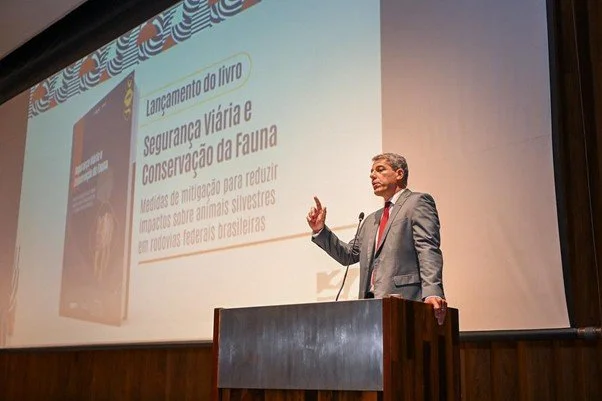
Brazil has taken a historic step by releasing its first national guidance integrating biodiversity conservation into federal highway infrastructure. Developed through collaboration among government, researchers, and practitioners, it offers science-based solutions to reduce wildlife-vehicle collisions and reconnect fragmented landscapes in one of the world’s most biodiverse countries.
Building a National Framework for Wildlife Mitigation
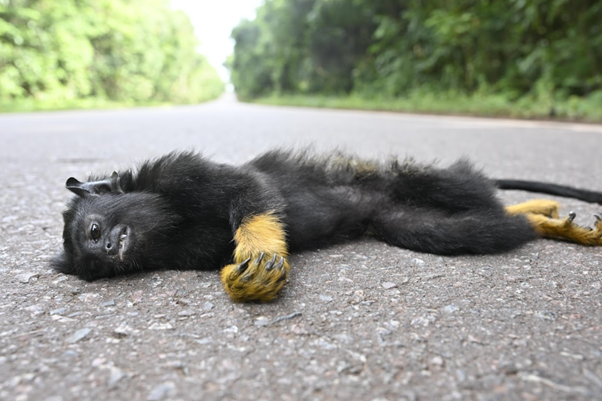
Golden-handed tamarin (Saguinus midas), a victim of a wildlife-vehicle collision on the BR-174 federal highway in northern Amazonas State, Brazil.
Brazil has one of the world’s largest road networks, spanning globally significant ecosystems such as the Amazon, Pantanal, Cerrado, and Atlantic Forest. While roads are essential for economic development and connectivity, they also generate major impacts on wildlife, including habitat fragmentation, barrier effects, and wildlife-vehicle collisions. In a megadiverse country like Brazil, these impacts affect hundreds of species, including threatened mammals, reptiles, birds, and amphibians.
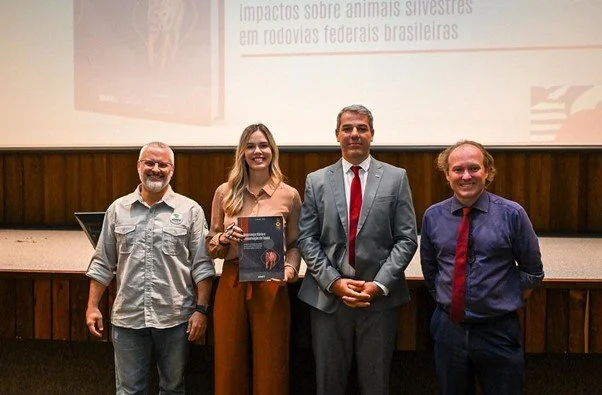
From left to right: Daniel Raíces, representative of the Chico Mendes Institute for Biodiversity Conservation (ICMBio), Dra. Fernanda Abra from ViaFAUNA and Smithsonian National Zoo Conservation Biology Institute, Dr. Luiz Guilherme Rodrigues de Mello, Director of DNIT, and Rodrigo Agostinho, president of the Brazilian Institute of Environment and Renewable Natural Resources (IBAMA).
Over the past two decades, road ecology in Brazil has advanced through collaborations among transportation agencies, environmental authorities, universities, conservation organizations, and the private sector. However, much of this knowledge remained scattered across scientific publications, environmental licensing reports, and individual projects. Engineers, consultants, and environmental agencies lacked a unified technical reference to guide the selection and design of mitigation measures.
This gap is particularly important because mitigation approaches developed in temperate regions are not always transferable to tropical ecosystems, where biodiversity, animal behavior, and landscape conditions differ substantially. Brazil therefore required guidance grounded in its own ecological context while aligned with international best practices.
In response, the Brazilian National Department of Transport Infrastructure (DNIT) led the development of the first edition of Road Safety and Wildlife Conservation: Mitigation Measures to Reduce Impacts on Wild Animals on Brazilian Federation Roads, officially launched in April 2026 in Portuguese. Developed with contributions from 58 professionals across 30 institutions, the handbook represents a major milestone for integrating biodiversity conservation into transportation infrastructure in Latin America.
“From the outset, the goal was not to produce another theoretical volume on road ecology. What was missing was a practical handbook for engineers, designers, and road managers. ”
The objective was therefore to translate scientific evidence and environmental policy into engineering guidance. The handbook transforms research, field experience, and environmental licensing practices into practical recommendations that can be applied in infrastructure projects. Every recommendation is grounded in scientific evidence while remaining technically feasible within the realities of Brazilian infrastructure.
Because wildlife mitigation is shaped by both engineering and governance, the handbook also explains Brazil’s environmental licensing process. It describes the federal framework applied to DNIT projects and highlights emerging state-level legislation on wildlife protection in road infrastructure. It also presents National Action Plans coordinated by ICMBio, which identify priorities for reducing road impacts on threatened species and help align infrastructure projects with national conservation strategies.
The handbook establishes DNIT's first minimum technical standards for wildlife mitigation on federal highways. Rather than prescribing a single solution, it provides a decision-making framework that allows practitioners select measures based on target species, landscape characteristics, road design, and project objectives. This approach recognizes that different ecological contexts require different solutions.
Developing these standards required extensive collaboration among engineers, ecologists, agencies, universities, consultants, and practitioners. Multiple rounds of review ensured that the guidance balances ecological effectiveness with engineering feasibility, making it both scientifically credible and operationally practical.
Turning Knowledge into Practice
One of the handbook's most significant contributions is its collection of detailed engineering drawings. For the first time, DNIT has published standardized designs that can serve as reference models for wildlife mitigation across Brazil.
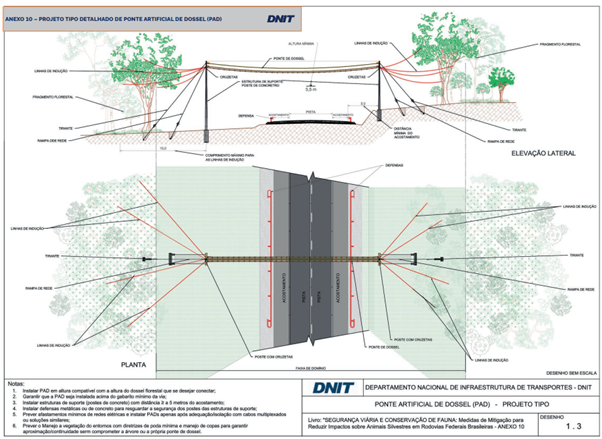
Example of the standardized artificial canopy bridge design presented in the technical annexes of the DNIT wildlife mitigation handbook.
The annexes include technical specifications for wildlife underpasses of various sizes, exclusion fencing designs, wildlife overpasses, artificial canopy bridges for arboreal species, escape structures, and complementary measures. They also introduce a new set of wildlife crossing signs featuring native species, replacing generic road signs with ones that better reflect Brazilian biodiversity.
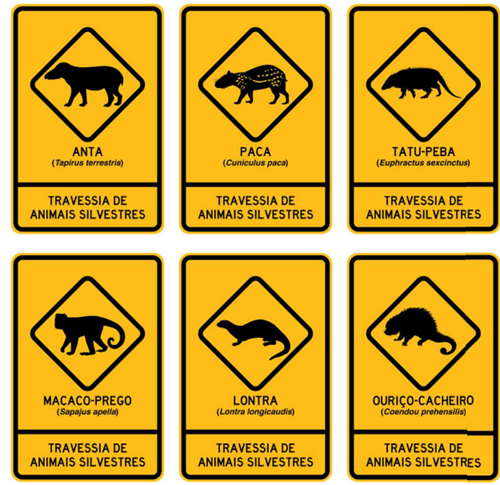
A new collection of wildlife crossing signs depicting native Brazilian mammal species, developed for the DNIT handbook.
These designs are more than illustrations. They provide practical templates that engineers can adapt to local conditions while maintaining consistent standards. By reducing uncertainty during project design, they promote greater consistency in mitigation implementation across the federal road network.
The handbook also includes seven case studies from six Brazilian states, documenting real-world applications of mitigation measures. These examples, contributed by researchers and engineers, demonstrate that wildlife mitigation is already being implemented across diverse regions and infrastructure contexts.
By showcasing these experiences, the handbook builds confidence among practitioners and underscores that Brazil is progressing toward more biodiversity-sensitive transportation. It also encourages the integration of mitigation measures from the earliest planning stages of road projects.
A Living Technical Reference
Beyond its technical contributions, the handbook represents a new model of collaboration between ecology and engineering. Researchers and practitioners worked together to integrate ecological data, monitoring results, and engineering expertise into a unified framework.
Importantly, the handbook is designed as a living document. It will be reviewed and updated at least every three years to incorporate new data, technologies, and lessons learned from implementation. This adaptive approach ensures that the guidance remains relevant and continues to improve over time.
DNIT also plans to publish English and Spanish editions to expand accessibility and share Brazil's experience internationally. This is especially relevant for tropical countries, where infrastructure expansion, biodiversity challenges and socioeconomic conditions differ from those in temperate regions. By providing practical, evidence-based guidance tailored to tropical systems, the handbook can support other nations in developing content-specific mitigation strategies.
Perhaps more importantly, the handbook establishes a common technical language among engineers, ecologists, agencies, consultants, and road managers. By creating shared standards and guidance, it lays the foundation for transportation systems that better balance human mobility with biodiversity conservation.
References
Abra, F. D., Prist, P. R., Cunha, J. F. L., & Mello, L. G. R. (Eds.). (2026). Segurança viária e conservação da fauna: Medidas de mitigação para reduzir impactos sobre animais silvestres em rodovias federais brasileiras. Departamento Nacional de Infraestrutura de Transportes (DNIT). ISBN 978-85-66988-13-0.
Author:
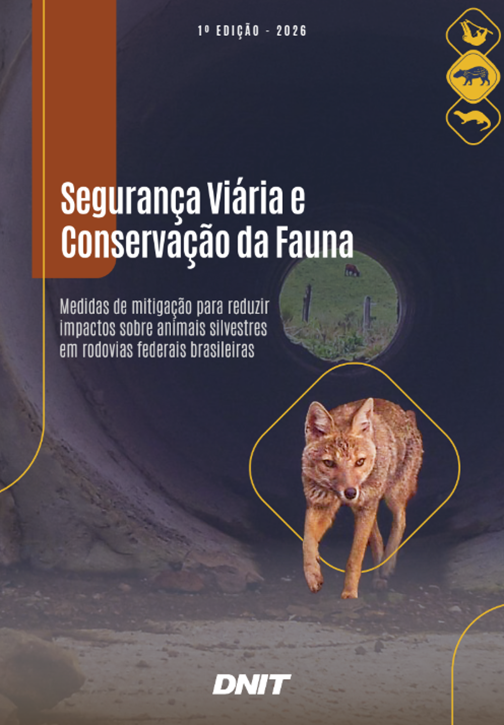
Cover of the DNIT wildlife mitigation handbook, Segurança Viária e Conservação da Fauna, officially launched in Brasília, Brazil, in April 2026.
Dr. Fernanda Delborgo Abra
Director of ViaFAUNA Estudos Ambientais, São Paulo, Brazil
Research Associate at Center for Conservation and Sustainability, Smithsonian National Zoo Conservation Biology Institute, Washington D.C., United States
Fernanda Abra is a Brazilian conservation biologist specializing in road ecology and sustainable infrastructure. She is the founder and president of Instituto Reconecta, co-founder and director of ViaFAUNA, a Research Associate at the Smithsonian National Zoo and Conservation Biology Institute (USA), and an associate researcher at the Institute for Ecological Research (IPÊ), Brazil.
Her work focuses on developing and implementing science-based solutions to reduce the impacts of roads on wildlife, particularly through canopy bridges, wildlife crossings, landscape connectivity, and mitigation planning. She has led pioneering projects across Brazil and South America that integrate ecological research, engineering, government agencies, Indigenous communities, and the private sector to make transportation infrastructure safer for both people and biodiversity.
Fernanda has contributed to national policies and technical guidelines for wildlife mitigation on Brazilian highways and has authored numerous scientific publications on road ecology and conservation.
Edited by: Melissa Butynski
Cite this case study:
Abra, FD. (2026). Brazil launches landmark guide for wildlife-safe transportation. Edited by Butynski, M. Transport Ecology.info, Accessed at https://transportecology.info/case-studies/practical-handbook-of-roadecology