

Reframing Fish Passage: From Single Metrics to Structured Complexity
May 20, 2026
Jason Gunn
The Fish Passage Action Team is an informal, non-profit collective of individuals concerned with or interested in the issues surrounding fish passage. The following is an introduction to a comprehensive discussion document created by the Team. The team is seeking input from ecologists, engineers, and regulators prior to publishing to a broader audience (see author info below).
Shifting the Paradigm in Fish Passage Design: From Simplistic Metrics to Structured Complexity
Traditionally, regulations for fish passage have relied on strict, long-standing criteria based on decades-old research. While ecologists recognized the inherent complexity of aquatic systems, translating this knowledge into quantifiable, compliance-based habitat standards has proved challenging. This necessity led to an oversimplification of dynamic environments, resulting in a set of design criteria that were easy to enforce but fundamentally simplistic and misleading. Design focus narrowed primarily to three conventional cornerstones:
Maximum average velocity
Maximum gradient
Avoid turbulence
However, these three metrics are insufficient in isolation:
Maximum average velocity is largely irrelevant for fish and is only accurately measurable in laminar type flows. Successful passage is determined by the maximum velocity encountered over a specific distance coupled with complexity. In heterogeneous (complex) flow fields, average velocity becomes ecologically inert because individual fish navigate radically different, often slower, flow paths around roughness elements.
Maximum gradient is misleading without considering crucial co-factors such as flow-rate, channel roughness, and overall hydraulic complexity. It is a proxy that obscures the operative variable: the spatial distribution of velocity across the cross-section and along the flow path.
Avoiding turbulence is an oversimplification. Turbulence encompasses various facets, and a thorough assessment is needed to determine if it truly constitutes a barrier to fish movement. This conventional approach, which produced homogeneous, symmetrical designs not found in nature, ignores that fish actively exploit organized, periodic vortex structures (Kármán gaiting) to reduce metabolic cost. High Turbulent Kinetic Energy (TKE) measurements alone fail to resolve this necessary temporal structure.
Latest research, including Computational Fluid Dynamics (CFD) simulation, indicates that fish primarily use three distinct mechanisms moving upstream through complex flows:
Burst Swimming: Short periods of high-energy, anoxic power-swimming, to push through high velocity zones.
Flow Refuging: Exploiting low-velocity zones (spatial heterogeneity) behind boulders, baffles, or within boundary layers as connected rest positions, allowing for incremental upstream progress without sustained swimming against the mean velocity.
Vortex Capture (Kármán Gaiting): Synchronizing body movements with organized, periodic vortex structures (temporal structure) to extract energy from the flow field and reduce muscular effort.
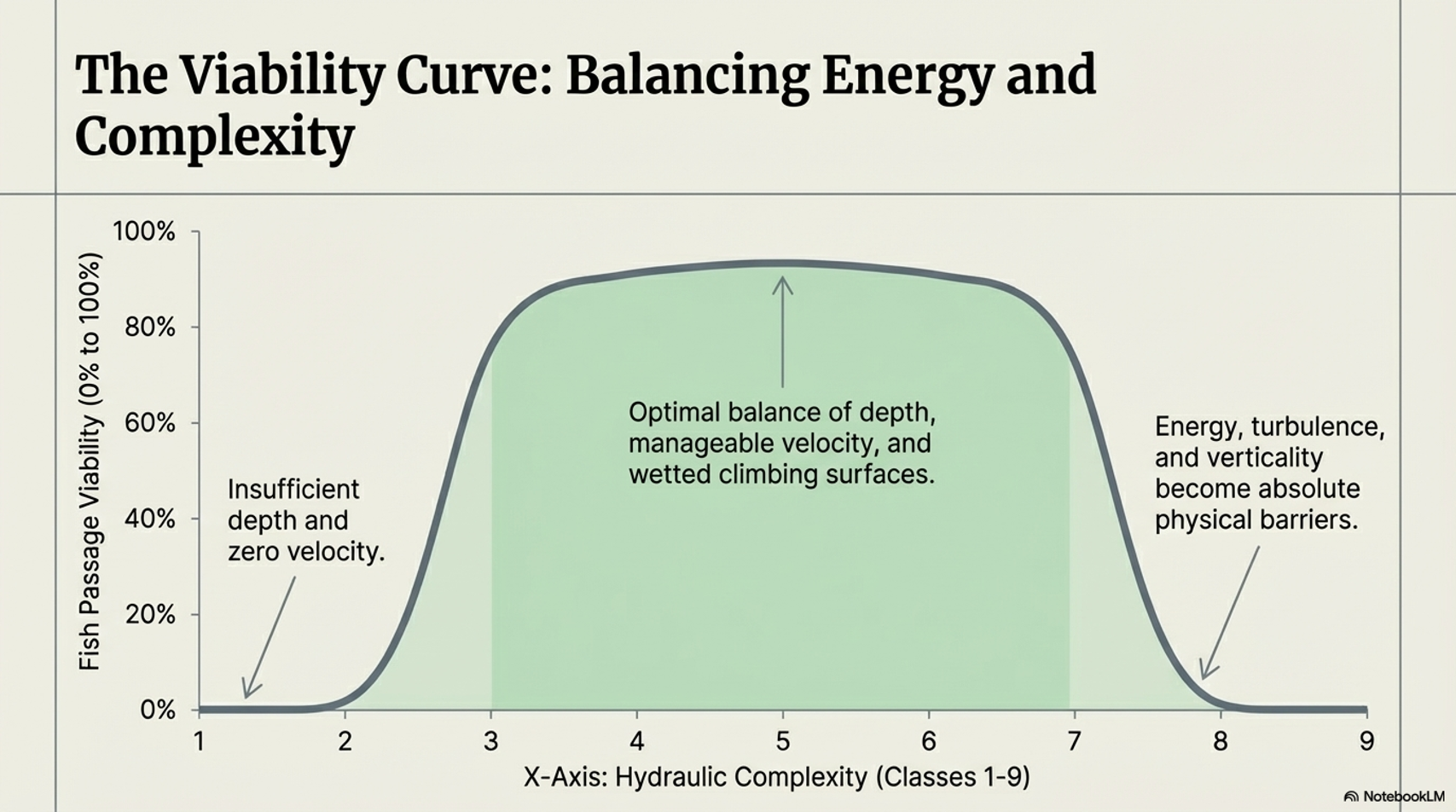
Chart showing where fish passage is most confidently achieved
Reframing assessment around flow complexity means the design target is no longer hydraulic uniformity; it is structured heterogeneity. The goal is to create a flow field that simultaneously contains fast and slow water, organized and dissipated vortex zones, and deep and shallow areas, allowing fish of different species and life stages to select a viable path. Roughness elements and baffles are considered architectural components that introduce essential spatial and temporal variation.
Depth is also critical, specifically the usable, low-velocity near-bed boundary layer, which is the navigable zone for small-bodied benthic species and scales with substrate roughness. Furthermore, heterogeneous flow paths force individual water particles to travel different routes, hydraulically "lengthening" the structure and reducing the effective gradient for slower paths.
For post-construction or post-remediation monitoring, a complexity-based assessment shifts the question from "did fish pass?" to "does this structure provide the hydraulic conditions within which fish passage is reasonable to expect?". This moves away from expensive, limited fish count surveys toward a structured visual assessment of flow complexity, depth, and connectivity, scored against the natural channel immediately upstream as a reference. This reference comparison is the key innovation, establishing hydraulic conditions for passage if the structure scores comparably to the natural reach.
To modernize, standardize, and strengthen fish passage guidance, a new descriptive and definitional approach is emerging. This contemporary framework centers on two key documents:
Fish Passage Principles & Outcomes (2025) (appendix 1)
The Flow Type Classification Metric (2026) (FTCM) (appendix 2)
These tools provide a comprehensive overview of the necessary environmental conditions for successful fish migration, offering meaningful design criteria with a high probability of success for diverse species and life stages. The overall challenge is to embrace this new understanding of aquatic mechanisms in both practical and regulatory frameworks to ensure consistency across designs, permits, and compliance monitoring.
The Fish Passage Action Team discussion document includes various contributors from ecology and engineering, sharing information and experiences via the fishpassageactionteam.org website and through email to an international audience of approximately 3000.
The team is seeking input from ecologists, engineers and regulators prior to publishing to a broader audience. Comments and suggestions can be sent to “info@fishpassageactionteam.org”
Contact person: Kelly Hughes
kellyh@ats-environmental.com
Fish passage practitioner and advocate (20+ years)
Memberships:
Fish Passage Action Team
NZ Fish Passage Advisory Group (foundation member)
NZ Freshwater Science Society
Edited by: Melissa Butynski
Cite this case study:
Fish Passage Action Team. (2026). Reframing fish passage: from single metrics to structured complexity. Edited by Butynski, M. Transport Ecology.info, Accessed at https://transportecology.info/case-studies/reframing-fish-passage