

The Hidden Infrastructure Reconnecting North America’s Wildlife, Explained
This case study is republished from “Yellowstone to Yukon - Conservation Initiative”
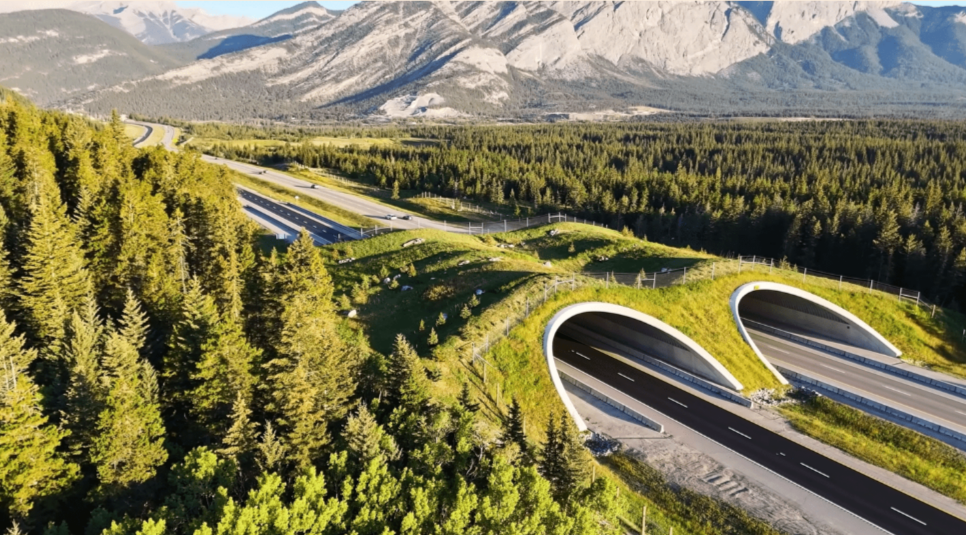
Photo: Planet Wild
Across the Yellowstone to Yukon region, grizzly bears, elk, and wolves are reclaiming their ancient migration routes — in part thanks to wildlife bridges, tunnels, and specialized fencing reconnecting one of the most spectacular landscapes on Earth.
The Yellowstone to Yukon Conservation Initiative (Y2Y) recently shared this story through a new film with Planet Wild. Each month, Planet Wild's members fund a new conservation mission somewhere in the world, and Planet Wild documents the story on their YouTube channel.
This month, they chose to feature Y2Y's efforts to reconnect wildlife habitat across highways in the Rockies. For Mission 36, their team visits the Yellowstone to Yukon region — the largest intact mountain system left on our planet — to explore how highways and railways have fragmented this wilderness, turning safe migration routes into deadly barriers for grizzly bears, elk, wolves, and many other species.
But solutions exist, and they work.
Purpose-built overpasses and underpasses, combined with specially designed fencing systems, are reconnecting isolated wildlife populations and saving lives.
The results are remarkable: crossings reduce wildlife-vehicle collisions by over 90%, with more than 150,000 documented animal crossings recorded in the Banff National Park system alone since the late 1990s.
In the film, the Planet Wild team visits the heart of the Yellowstone to Yukon region, talking with Bill Hunt, Y2Y's senior director of conservation programs, and experts such as Dr. Clayton Lamb.
The host and crew learn more about the highly successful network of crossings along Highway 1 in and near Banff National Park, before exploring Y2Y's current work with partners on Highway 3 in southern B.C. and Alberta — a critical project to Reconnect the Rockies.
Y2Y was delighted to partner with Planet Wild and to have their support to supply Y2Y's partners with essential research tools such as trail cameras and GPS collars. These will provide the hard data needed to make the case for future crossings along Highway 3 and measure their effectiveness.
Y2Y's ambitious vision will take decades to fully realize. But every crossing built, every animal that safely makes it across, proves it's not just achievable — it's essential.
Watch the film to see how engineering, ecology, and collaboration are reimagining what's possible for wildlife conservation:
This story was originally published on the Yellowstone to Yukon Conservation Initiative website. To learn more about Y2Y's wildlife connectivity work, explore their research on wildlife crossings, or discover how you can support habitat reconnection efforts across the Yellowstone to Yukon region, visit y2y.net or follow their latest updates at y2y.net/blog.