

Every collision counts: Building Norway’s 13-Year National Database of railway wildlife mortality
February 6, 2026
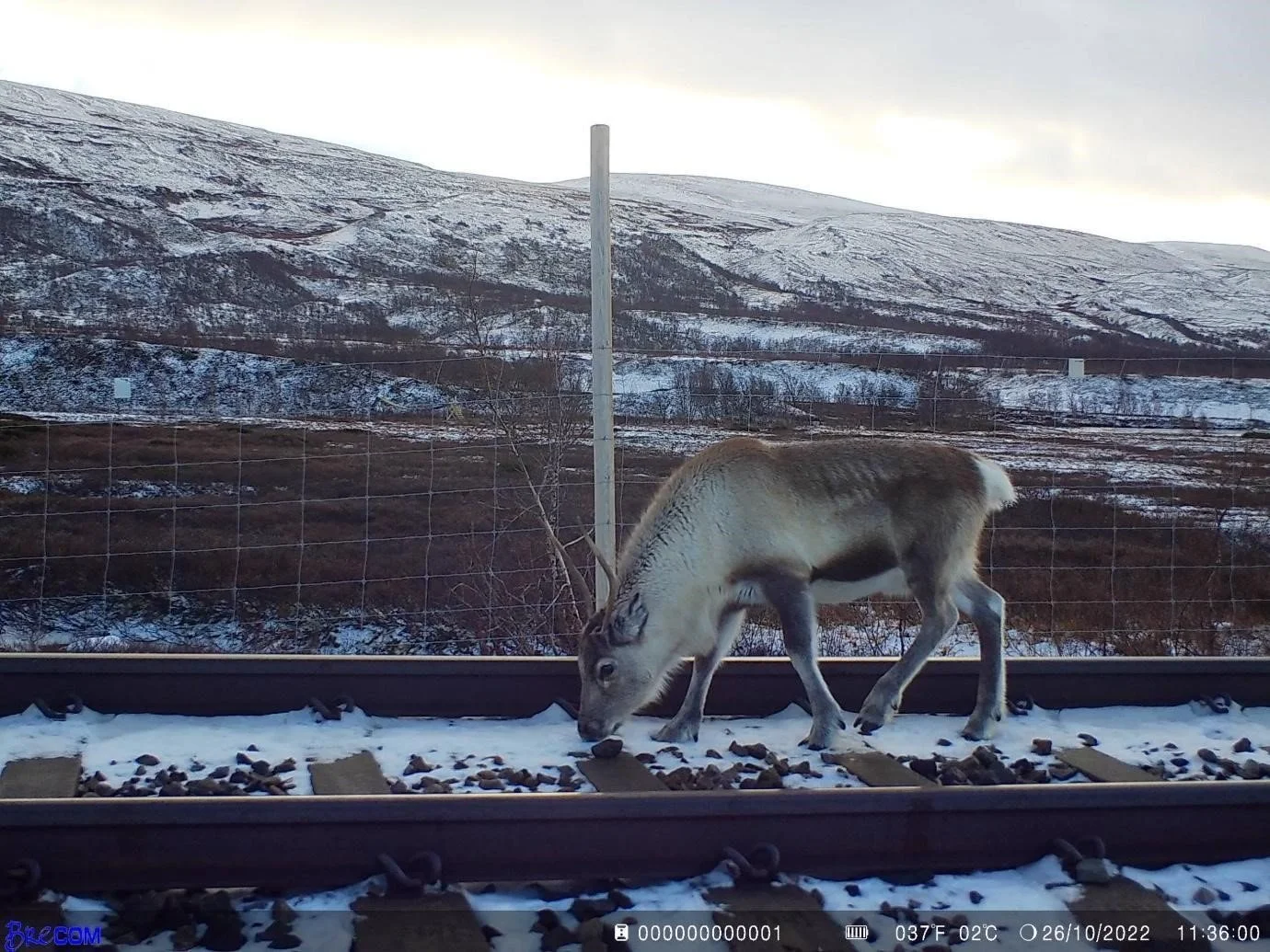
Courtesy of Bane NOR
For more than 10 years, Bane NOR has compiled data on train-animal collisions on the Norwegian railway network based on internal systematic reporting procedures that also include relevant environmental parameters. While a summary of the data is made public in their Annual Report each year, the extensive data for the period 2012 – 2024 is now also made publicly accessible through the RISKY project (www.risky.pt). RISKY aims to compile, standardize, and provide open-access wildlife mortality data from energy and transport infrastructures to support research and evidence-based mitigation.
The Norwegian Railway Data Collection Initiative
Since 2012, Norway's state-owned railway infrastructure manager, Bane NOR, has systematically documented every train-animal collision across the country's entire rail network. Bane NOR oversees everything from tracks and stations to traffic management across five operational divisions: Construction, Operation and Maintenance, Traffic, Digitalisation and Technology, and Property and Railway Facilities. This 13-year dataset represents one of the most comprehensive national records of railway wildlife mortality in Europe.
Procedure for Data Collection
All incidents related to train collisions on the Norwegian railway network are recorded with a range of environmental data for the site, as well as specific information about the animals. Bane NOR has an internal procedure for handling and reporting of incidents of train-animal collision (STY-605014 Håndtering av dyrepåkjørsler), which covers:
● Train drivers’ routines to alert the traffic control center to incidents involving animal collisions, which in turn notify the local maintenance crew responsible for assessing the situation and notifying relevant governmental bodies or animal owners.
● The traffic control center reposts all incidents to an internal incident register
○ Time of incident
○ Place of incident
○ Species and number of animals
○ Train identity number of the involved train
● The local maintenance crew reviews and corrects information in the incident report and reports all additional relevant information to the internal database.
○ Outcome for traffic (delay, and duration of delay)
○ Number of animals involved and outcome for the animal
○ Sex and age of the animal
○ Environmental data at the site (e.g. vegetation, tree cover, presence of fencing, and snow depth)
○ Action taken regarding alerting relevant governmental bodies or animal owners
Results
Ungulates and carnivores are the taxonomic groups most frequently detected as carcasses along railways. The species with the highest number of recorded railkills is the moose (Alces alces; n = 9,023), followed by the roe deer (Capreolus capreolus; n = 5,419) and the red deer (Cervus elaphus; n = 971) (Fig. 1a). Among carnivores, the Eurasian badger (Meles meles, n= 329) and the red fox (Vulpes vulpes, n=292) show the highest numbers of railkill records (Fig. 1b). Domestic species are also affected, with semi-domesticated reindeer (Rangifer tarandus, n=5,792) and sheep (Ovis aries, n=3,182) being the most frequently recorded domestic animals involved in railway collisions.
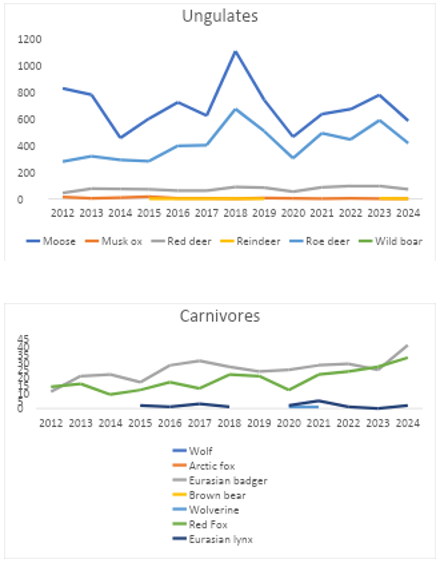
Figure 1 - Temporal patterns of railway mortality in Norwegian carnivores and ungulates, including semi-domesticated reindeer.
Lessons Learned
The database provides risk-based guidance for mitigation efforts. To ensure the quality of the reported data, it is essential to balance the time spent reporting with the data that needs to be collected. Using an internally developed reporting app, data can be collected on-site and easily corrected later. It is essential that the report to the database is well structured and in accordance with the procedure. The initial reporting was developed by environmental managers with input from the maintenance crew and later reviewed after recommendations from a scientific study (Rolandsen 2015). Over time, some environmental data at the site may be deemed non-essential or replaced by other sources to ensure the data remains relevant and is collected efficiently.
A valuable lesson is that the maintenance crew collecting the data needs to understand for what purpose the data will be used, to ensure sufficient quality and avoid unnecessary time. A sense of ownership of the data collection process within the organisation has resulted in a high-quality, consistent dataset over time.
The data underpins internal goals to reduce collisions between trains and animals and is widely available to the organisation through the internal dashboard and maps. Any mistakes in the reporting, abnormalities, and early worrying trends are thus easily spotted.
While Bane NOR manages all railways in Norway, municipalities also maintain wildlife-mortality registers as part of their hunting and wildlife-management responsibilities. However, these governmental registers only cover large ungulates, exclude domestic and semi-domesticated animals (including reindeer), and depend on Bane NOR's compliance with notification requirements. This makes Bane NOR's internal database the most comprehensive and consistent record of railway wildlife mortality. The internal database enables open communication with the public and supports compliance with internal routines to ensure good business practice in meeting daily challenges.
Authored by: Marit Linnerud
References cited:
Rolandsen, C. M., Solberg, E. J., Van Moorter, B. & Strand, O. 2015. Dyrepåkjørsler på jernbanen i Norge 1991–2014. – NINA Rapport 1145. 111 s.
Edited by: Melissa Butynski
Cite this case study:
Linnerud, M. (2026). Every Collision Counts: Building Norway's 13-Year National Database of Railway Wildlife Mortality. Edited by Butynski, M. Transport Ecology.info, Accessed at https://transportecology.info/case-studies/Norway-raillkill-database