

Written by Jonathan Wilansky & Jochen A.G. Jaeger
May 18, 2026
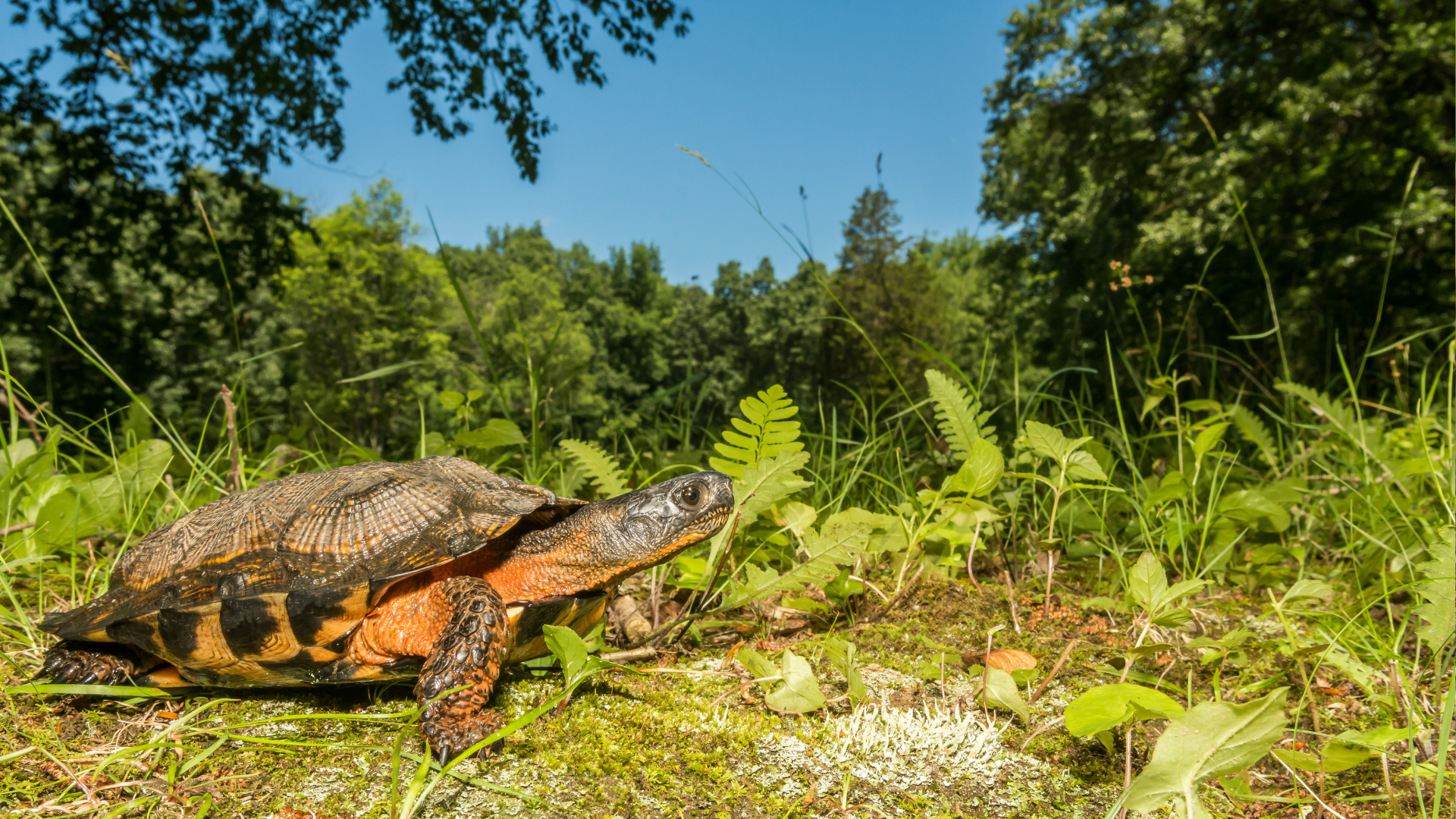
Wood turtle by Jason Ondreicka (Getty Images)
The Problem: Wildlife-Vehicle Collisions
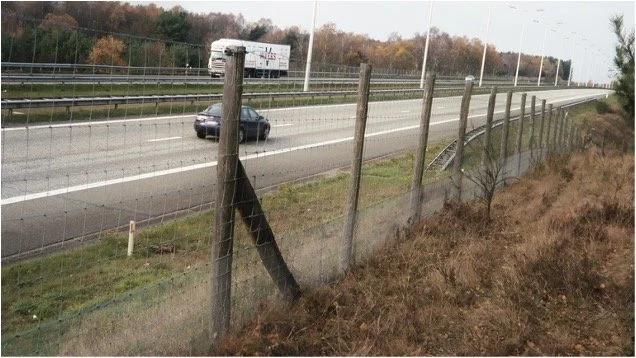
Figure 1: This fence to prevent deer from accessing a motorway in Switzerland also has smaller meshes at the bottom for small fauna. All motorways in Switzerland are fenced. (Photo by Jochen Jaeger.)
Wildlife-vehicle collisions (WVCs) threaten the viability of animal populations and pose a potentially lethal risk to motorists. These incidents occur with alarming frequency. In the USA alone, 1–2 million collisions with large mammals occur annually, imposing a massive financial, human and ecological toll on society. Beyond the danger to motorists, these incidents reduce the abundance of wildlife populations and often push vulnerable populations toward local extinction.
Mitigation Pitfall: Short Fences and the Fence-end Effect
While wildlife fencing is the go-to solution for reducing WVCs, its implementation is often constrained by topography, the presence of driveways and farm gates, or cost-saving decisions. This can result in fences that are ineffective because they are too short or contain gaps. These fences contribute to a ‘fence-end effect’, when animals encountering the fence simply follow it until an opening, and attempt to cross the road or railway there. Short fences rarely eliminate WVCs; they merely shift them to a new location, as illustrated in Figure 2. A fence must be long enough to account for the movement distances of the target species to prevent this effect.
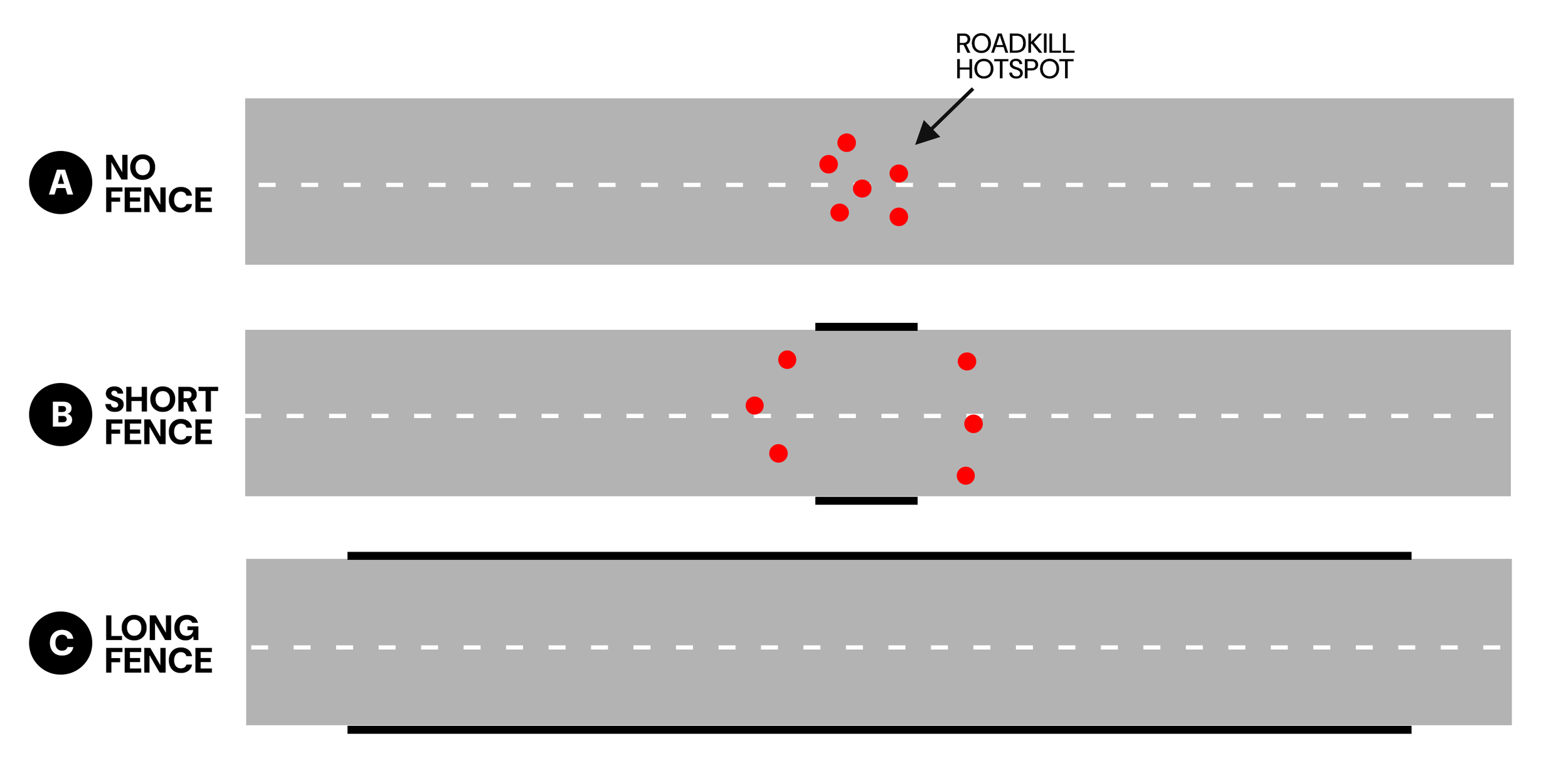
Figure 2: When a roadkill hotspot is identified (A), fences are often proposed. However, if the fence is too short (B), animals encountering the fence may simply follow it and attempt to cross the road at the fence ends. Part (C) depicts a much longer fence to counteract this fence-end effect. Red dots represent roadkill.
Although the fence-end effect has been widely recognized, it is not well understood and empirical data are rare. Our recently published study addresses this issue and answers the important question: How long must a fence be in order to be effective?
Method: A Simulation Approach
Our study used a computer simulation approach to predict the effectiveness of wildlife fences. We created an ‘individual-based’ model that was designed to simulate the movement of animals in a theoretical environment next to a road, using wood turtles as a model species.
We used published data about wood turtles to define their home-range size (600 m diameter) and an annual movement distance of about 16.3 km. We then simulated a range of fence lengths and established mathematical functions for 8 different fence-following behaviors.
Influence of the Fence-Following Behavior
Our simulations showed that the fence-following distance was the main behavior of animals that contributes to the fence-end effect. However, fence-following distances have only been documented for a handful of amphibian and reptile species. For this reason, we experimented with eight different fence-following distances to understand their influence on fence effectiveness, and to be able to plan for the worst-case scenario (i.e., by considering the longest of distances).
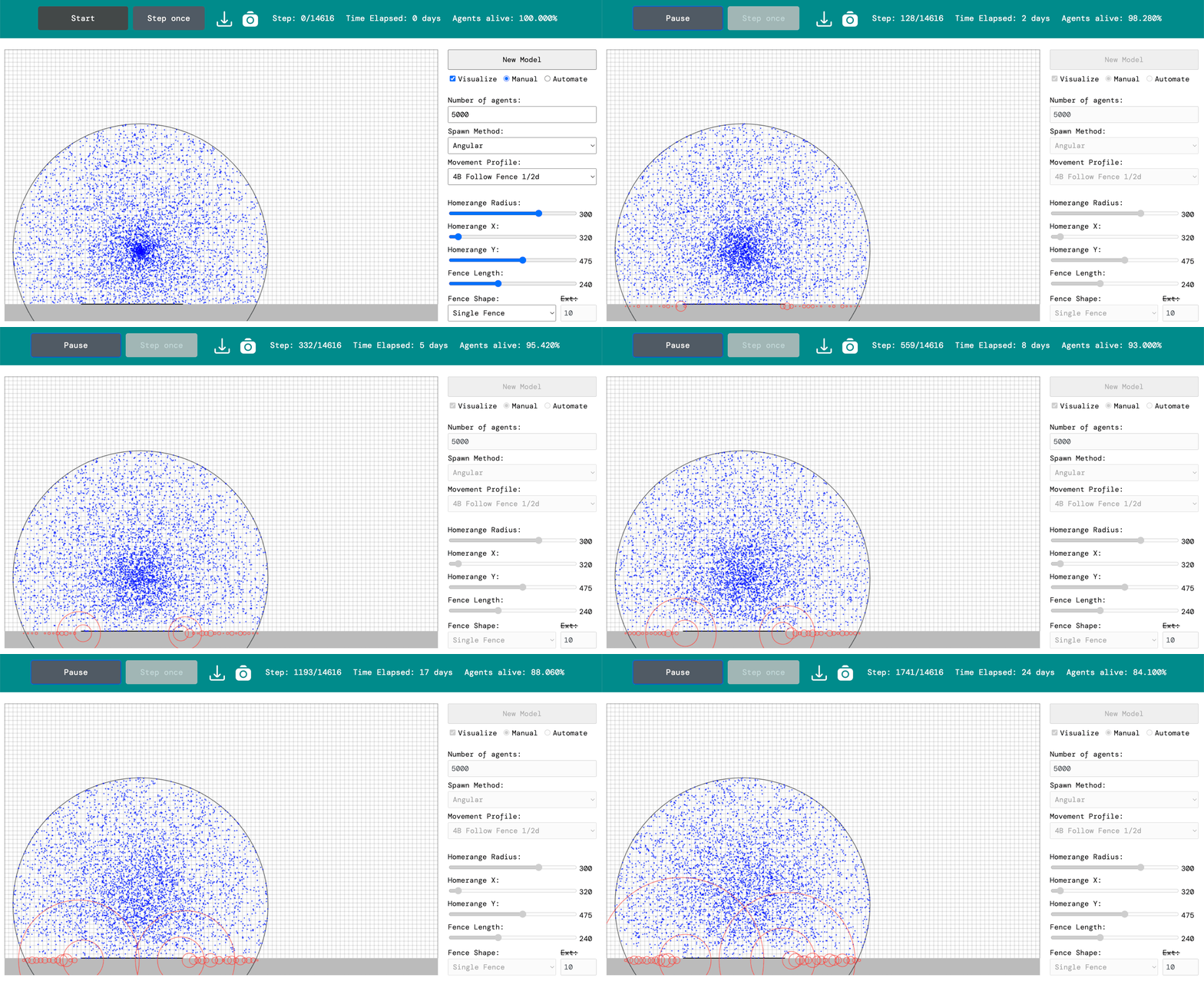
Figure 3: Animated screenshot of the model running in a web browser. The image shows a simulation for turtles for an example of a home range bisected by a road, with a short fence (length L = 240 m). The road is shown in grey, and the fence is drawn as a black line. The black circle depicts the maximum home-range boundary of a single turtle, and each blue dot represents one of 5000 simulated turtles in the model, illustrating diverse movement patterns possible within the home range. The red circles correspond to locations where at least one turtle encountered the road, with the circle’s radius proportional to the number of road encounters (i.e. potential roadkill) on that cell. The large red circles at the end of the simulation are all centred on the ends of the fence, showing how most of the potential roadkill has been pushed to each end of the fence
Key Findings
We found that fence effectiveness for wood turtles was influenced by the length of the fence and the distance the turtles followed the fence (Figure 4). In simple terms, the farther the turtles moved, the longer the fence needed to be!
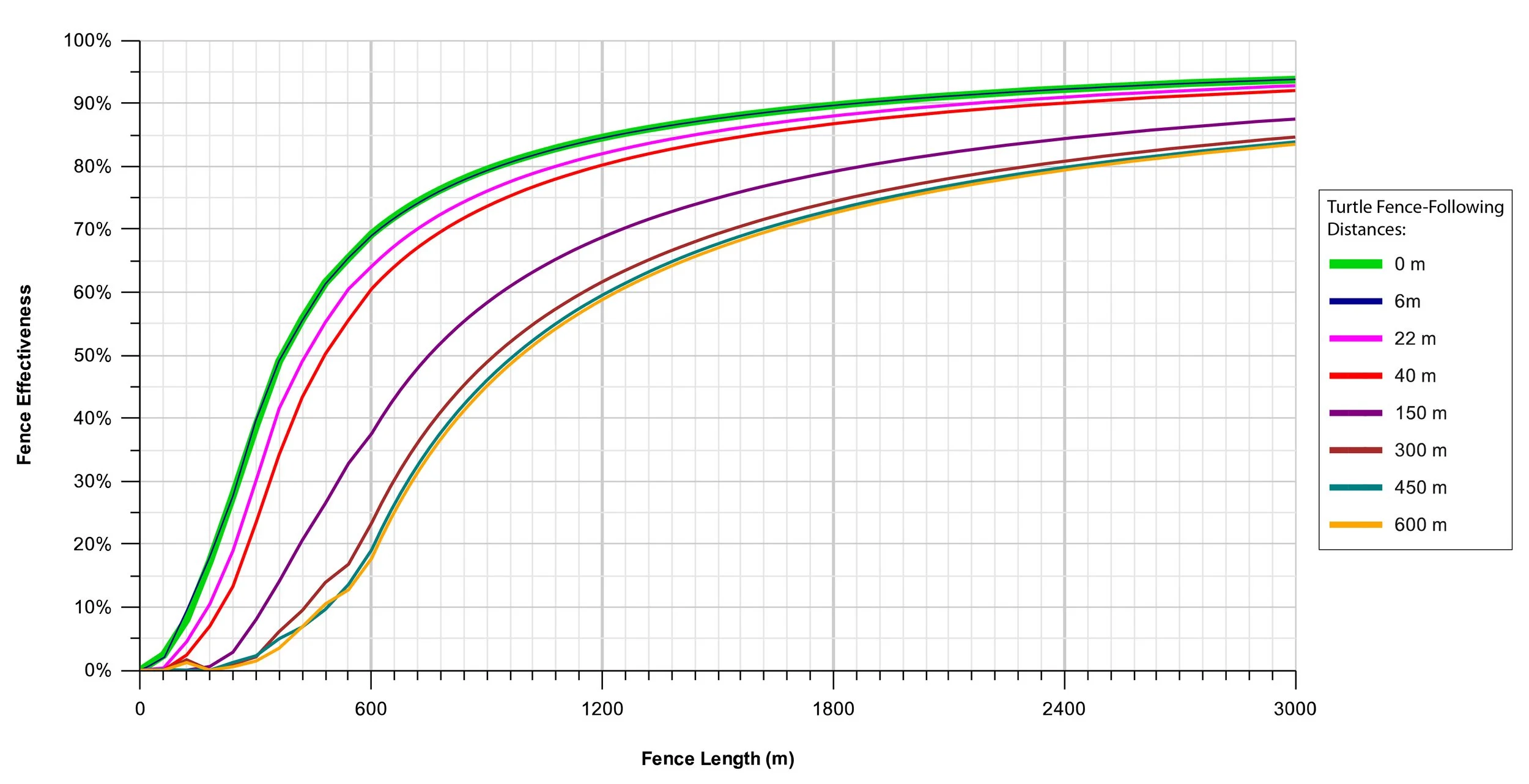
Figure 4: Fence effectiveness as a function of fence length for wood turtles and eight different potential fence-following behaviors. Effectiveness (shown on vertical axis) increased with fence length (on horizontal axis) and longer fences are needed for animals that moved larger distances.
The model revealed a strong relationship between fence length and fence effectiveness, further influenced by the fence-following distance for wood turtles:
Short Fences (shorter than 600 m): Highly ineffective (0% - 69%); many animals navigate around the fence ends. This failure is exacerbated by turtles following the fence for long distances.
Fences of Intermediate Length (between 600 m and 2,400 m): Effectiveness increases with length (18 - 93 %); longer fences begin to counteract the turtles’ fence-following behavior.
Long Fences (longer than 2,400 m): Effectiveness approaches but never achieves 100% due to the persistent open fence ends (80 - 95%).
Influence of the Animals’ Behavior: Fence effectiveness dropped more or less proportionately to the animals’ fence-following distance.
These results show that:
1. very short fences (shorter than 300 m) are almost useless for wood turtles if turtles follow the fence in a substantial way (i.e., for more than 150 m);
2. longer fences are significantly more effective because they counteract the fence-end effect; and
3. when the animals follow the fence for greater distances, this will drastically reduce a fence’s effectiveness, so the fences need to be even longer to remain effective.
These results are important to keep in mind when investing in wildlife fencing projects to ensure that they are effective. When a roadkill ‘hotspot’ is identified, it is crucial that the fence be long enough to mitigate the fence-end effect caused by animals following the fence. It should also cover the entire area of interest, e.g., the area in which the target species occurs.
Since fence-following distances are still unknown in practice, we recommend planning for animals that follow fences for long distances, e.g., until the limit of their home ranges. We call for empirical studies to determine the fence-following distances for all species of interest.
Significance: Guidelines for Practitioners
This study provides a tool for road-mitigation planning. Instead of assuming a fixed effectiveness (e.g., 80%), planners can use the fence-effectiveness formula (provided in the published paper) to choose lengths that will meet specific safety and conservation targets.
Although the model in this study was developed for wood turtles, it can be adjusted for any other species for whom home-range size and movement distances are known.
We propose a general rule for hotspots: The fence should cover the entire length of the target area (e.g., a roadkill hotspot) plus an additional minimum road stretch of length equal to the radius of the home range on both sides (e.g., 300 m for wood turtles). This buffer will help mitigate the fence-end effect and ensure that the fence will actually protect wildlife and motorists.
Educational Tool
The model runs in a web-browser with a visual component that can be used as an interactive educational tool to see the fence-end effect in action. By adjusting parameters such as fence length and fence-following distance, users can immediately visualize how human infrastructure and animal behavior interact. Importantly, it makes the processes behind the fence-end effect intuitive and complex spatial ecology accessible to non-experts.
Author information
Jonathan Wilansky - Department of Geography, Planning and Environment, Concordia University Montreal, 1455 de Maisonneuve Blvd. West, Suite H1255, Montréal, Québec, H3G 1M8, Canada. Jonathan is a PhD student specializing in computer simulations and serious games applied to environmental challenges, specifically in wildlife mitigation and waste management. Beyond his academic work, Jonathan promotes environmental awareness through creative means, such as his project upcycling discarded CDs into intricate sculptures.
Jochen A. G. Jaeger - Department of Geography, Planning and Environment, Concordia University Montreal, 1455 de Maisonneuve Blvd. West, Suite H1255, Montréal, Québec, H3G 1M8, Canada. He is interested in trans-disciplinary and holistic approaches to research and the work in his lab focuses on road mitigation measures, landscape fragmentation, urban sprawl, and environmental impact assessment.
Source citation
Wilansky, J., & Jaeger, J. A. G. (2024). Predicting the effectiveness of wildlife fencing along roads using an individual-based model: How do fence-following distances influence the fence-end effect? Ecological Modelling, 495, 110784. https://doi.org/10.1016/j.ecolmodel.2024.110784
Readers who are interested in using the model are welcome to contact Jonathan Wilansky at jonathan.wilansky@gmail.com.
Editor:
Rodney van der Ree
Cite this summary:
Wilansky, J. & Jaeger, J.A.G. (2026). Predicting the Effectiveness of Wildlife Fences Along Roads: How Long is Long Enough? Edited by van der Ree, R. TransportEcology.info, Accessed at: https://transportecology.info/research/fence-lengths-simulation