

November 28, 2025

Tagged Cinerous Vulture chick, in the nest © Carlos Pacheco
When ICNF (Institute for Nature Conservation and Forests) technicians first spotted a dark spot at the top of a stone pine tree in Serra do Mendro (southern Portugal), few could have imagined that the discovery would mark a turning point in the conservation of the rarest vulture species in Portugal. It was June 2024, and a new colony of Cinereous Vultures (Aegypius monachus) – the fifth known in Portugal – had just been discovered.
Only one year later, the excitement had given way to concern. The colony lies at the heart of a region increasingly in demand for renewable-energy infrastructure: solar megaprojects, windfarms, and high-voltage lines all jostle for space around the same ridges where vultures are rebuilding their future. Conservationists warn that without urgent action, the very forces driving Portugal’s green transition could condemn one of its most fragile wildlife recoveries.
A fragile comeback
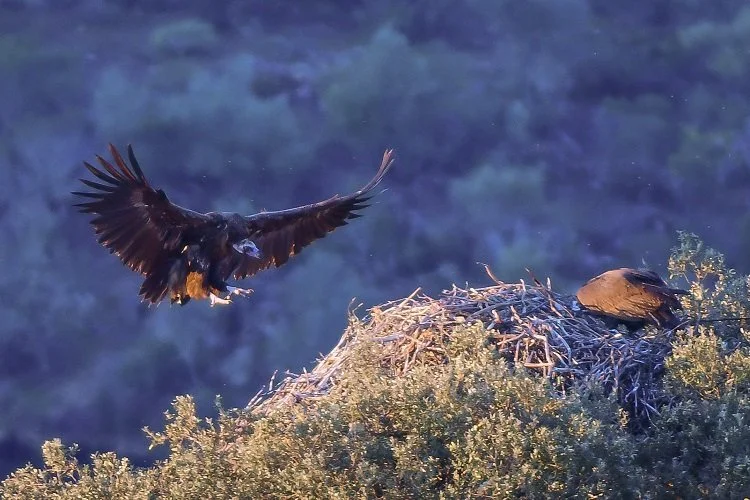
© PauloMonteiro
The discovery of the colony, now stretching across the municipalities of Vidigueira and Portel, was a milestone in Portugal’s vulture conservation story. After becoming extinct as a breeder in the country in the 1970s, the Cinereous Vulture has made a slow return over the past two decades, thanks to conservation action in Spain and Portugal. The consolidation of this landmark wildlife comeback is being led by the LIFE Aegypius Return project (2022-2027).
Currently, only five breeding colonies are known in Portugal, and two are particularly fragile. In Douro Internacional – the smaller and most isolated colony – six out of the eight nests known in 2025 burned or were affected by wildfires. The Serra do Mendro colony – with only 12 breeding pairs – is strangled by green energy planning.
Strategic colony for the conservation of the Cinereous Vulture
The colony of Serra do Mendro holds strategic importance for the conservation of the Cinereous Vulture in Portugal, particularly in the south of the country. It is the westernmost colony known for the species and the only colony in Portugal located away from the Spanish border, about 60 km from the nearest breeding site, at Herdade da Contenda.
Given the high level of philopatry – the tendency of individuals to return to their birthplace – that characterises the species, the establishment of new colonies far from existing ones is a rare phenomenon and may take several decades. Therefore, the survival and growth of this recent colony are absolutely crucial to consolidating the population in southern Portugal, strengthening connectivity between breeding nuclei, and fostering the recolonisation of the species’ historical range.
Yet the very geography that makes Serra do Mendro so significant – its open slopes and proximity to the Alqueva reservoir, one of Europe’s largest artificial lakes – also makes it a magnet for energy developers.

Serra Mendro © MileneMatos
Collisions, disturbance, and loss of habitat
Numerous energy production and transmission projects were planned before the presence of the Cinereous Vulture colony was known. Without urgent protection measures, the scale and concentration of these developments will become incompatible with the survival of the colony and with the conservation of other large bird species.
The Cinereous Vulture is sensitive to disturbance. It requires extensive feeding areas and very quiet breeding sites; otherwise, it won’t be able to reproduce. It is also very sensitive to collisions with wind turbines and power lines, as well as electrocution on medium-voltage power lines. Vulnerability is particularly high among juveniles when they explore their home territory with little flight experience.
A recent VCF study (Guilherme, 2025) under the LIFE Aegypius Return project quantified just how dangerous proximity can be. To protect the core areas (i.e. the area where each individual spends about half its time) of 50% of juveniles, turbines must be located at least 7.7 kilometres away from the nests. In Serra do Mendro, some of the proposed turbines would sit barely two kilometres away.
At such distances, mortality rates would soar. Even a handful of fatalities could doom the colony’s future, given that pairs raise only one chick per year and don’t breed until age four or five. As seen elsewhere (Vasilakis et al., 2016), each collision represents years of conservation work lost. Indeed, in northeast Greece, the establishment of windfarms near a historical breeding colony is having population-level impact on this species. We need to avoid the same happening in southern Portugal.
Beyond direct collisions, energy infrastructure fragments the vultures’ feeding range. Construction roads and maintenance activity drive the shy birds away from eventual carcasses; vast solar fields erase open foraging habitat. Noise and human movement near nests can cause adults to abandon eggs or chicks.
A test for Portugal’s green transition
Portugal prides itself on being a renewable-energy pioneer. In 2024, wind and solar supplied more than 70% of the country’s electricity, and policymakers are racing to meet EU targets for 2030. Conservationists obviously support this green transition. Yet the rush to build clean power often collides with other European obligations – notably, to safeguard biodiversity under the Birds and Habitats Directives.
The Mendro case reveals a systemic blind spot. Environmental Impact Assessments are carried out for each project, but cumulative impacts are seldom examined with the scope or urgency they deserve – even though it is precisely their combined effect that can transform an ecosystem beyond recognition.
The LIFE Aegypius Return project partners clearly support the energy transition, but not at any cost. The benefits of green energy cannot come at the expense of biodiversity and the life-supporting ecosystem services that ultimately sustain the economy itself.
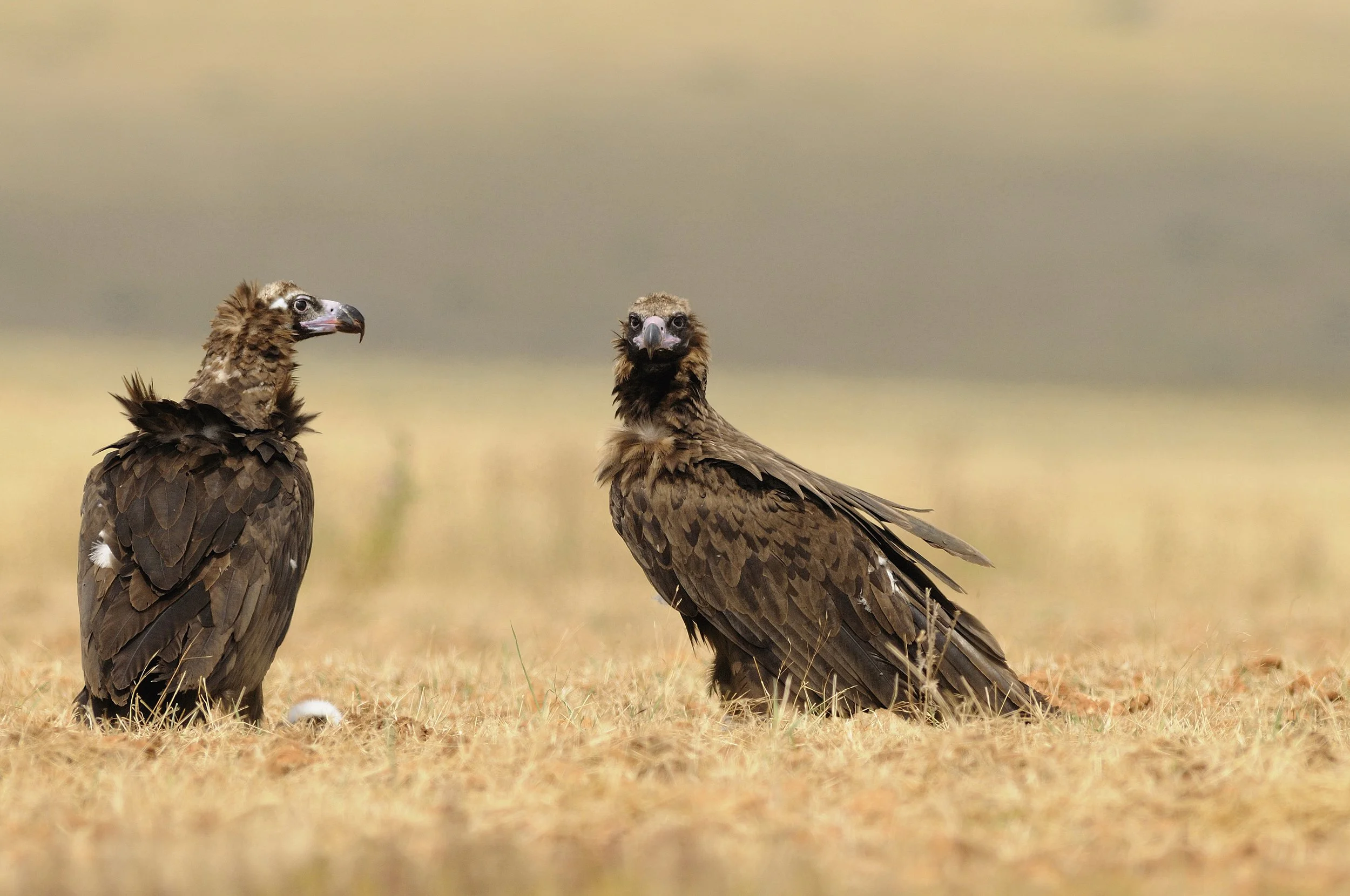
© BrunoBerthemy
Searching for coexistence
For now, the LIFE Aegypius Return consortium is pursuing a two-track strategy: dialogue and defence. Project partners have been actively collaborating with authorities, promoters and consultants, both through technical meetings and detailed opinions, offering data and guidelines to reduce risk.
The project also advocates stronger legal protection for Serra do Mendro itself. Despite hosting rare raptors such as Golden Eagles (Aquila chrysaetos) and Bonelli’s Eagles (Aquila fasciata), the area has no national or EU-level conservation designation. Classifying it as a protected site under the Birds Directive could restrict incompatible developments.
Lessons from the sky
The story of Serra do Mendro is not just about one colony or one species. It’s about whether Europe can build its renewable future without repeating the mistakes of its industrial past.
Over the past two years, the partners of the LIFE Aegypius Return project have laid out an extraordinary body of technical evidence. Using data from GPS-tagged vultures, case studies of collision and electrocution mortality, and proven mitigation practices from other regions, they have produced detailed studies, guidance documents and technical opinions in every public consultation related to the projects affecting the area. Their aim has been clear: to provide decision-makers and developers with the best possible scientific information to reconcile renewable-energy expansion with the conservation of one of Europe’s rarest birds.
For now, the team remains cautiously hopeful that all parties – from government authorities to energy companies and the drivers of the green transition – will act with common sense and find practical ways to mitigate risks and offset inevitable losses within reason.
Yet, as with all conservation stories, the outcome will depend on time and on choices still to be made. The Cinereous Vulture’s return to Portugal is a symbol of resilience.
References cited
Guilherme, J., 2025. Spatial guidelines for safeguarding Cinereous Vulture colonies from wind farm expansion. Vulture Conservation Foundation | LIFE Aegypius Return. https://doi.org/10.5281/zenodo.16971205
Vasilakis, D.P., Whitfield, D.P., Schindler, S., Poirazidis, K.S. and Kati, V., 2016. Reconciling endangered species conservation with wind farm development: Cinereous vultures (Aegypius monachus) in south-eastern Europe. Biological Conservation, 196, 10-17. https://doi.org/10.1016/j.biocon.2016.01.014
Authors
Milene Matos; m.matos@4vultures.org
Coordinator of the LIFE Aegypius Return project; Vulture Conservation Foundation
José Pedro Tavares; j.tavares@4vultures.org
Director of the Vulture Conservation Foundation
Editor:
Melissa Butynski
Cite this case study:
Matos, M., & Tavares, J. (2025). Wildlife in peril: Portugal’s Newest Cinereous Vulture Colony Faces an Energy-Infrastructure Storm. Edited by Butynski, M. Transport Ecology.info, Accessed at https://transportecology.info/case-studies/cinereous-vulture-portugal