

Shifting gears - Humanity needs roads and other infrastructure. But how can we minimize infrastructure’s negative impacts and allow nature to thrive?
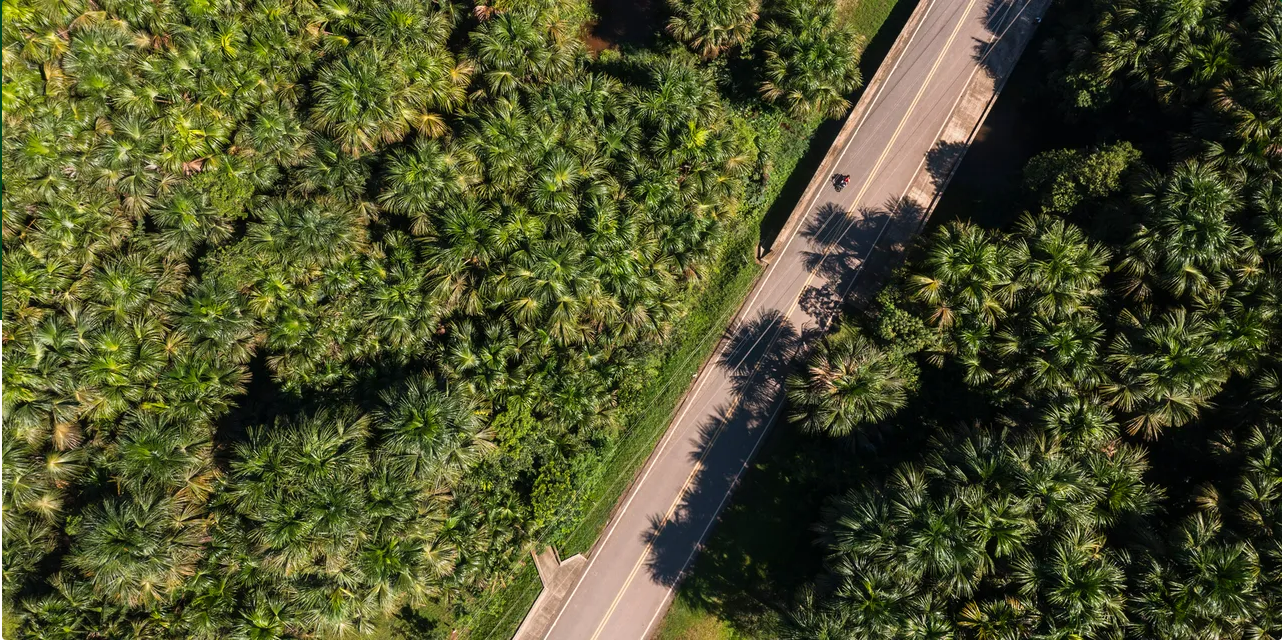
PILOT ROAD: The project being implemented along the El Retorno-Calamar road in Guaviare, Colombia, will help reduce negative environmental impacts and improve connectivity. © WWF-US/Luis Bernardo Cano
The white glare of the equatorial sun makes the air shimmer as a light breeze raises dust from the roadbed. A tangle of trees native to the Colombian Amazon—moriche palm, macano, carob tree—draped with vines and epiphytes stands nearby. Two construction workers take a break in the shade as an excavator spreads gravel over a layer of compacted soil, cut and shaped from the existing terrain. At first glance, it looks like they’re constructing a standard road with layers of gravel compacted and leveled to provide stability and drainage for the asphalt laid on top.
But despite its conventional appearance, this road is unique. Running through Guaviare in south-central Colombia—a region with some of the highest rates of deforestation in the country—it’s the first deteriorated road being rebuilt and updated to follow the pioneering Green Road Infrastructure (GRI) Guidelines, which recently became mandatory in Colombia.
To grasp why this approach can help conserve species and habitats and why it signals the start of a global shift, it’s important to understand the impact roads and other infrastructure have on nature.
© WWF/Matt Twombly
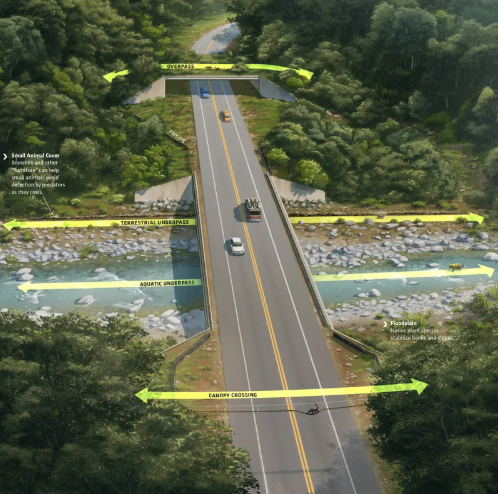
Interventions
The following interventions help maintain ecological connectivity and allow species to move from one part of a habitat to another, overcoming the obstacle of a road.
Overpass
This type of crossing, especially when combined with fencing, can create safety for animals seeking to cross a road.
Small animal cover
Branches and other “furniture” can help small animals avoid detection by predators as they cross.
Fencing
This can direct species to wildlife crossings and away from a road, helping them avoid collisions.
Underpass
These are crossings under a road that allow species to cross safely.
Floodplain
Native plant species stabilize banks and slopes.
Canopy crossing
Tree-dwelling species—from monkeys to squirrels— can use this structure to get from one side of the road to the other safely.
Unintended consequences
During her first real job in 1984, for USAID in the Democratic Republic of the Congo, Kate Newman, WWF’s vice president for sustainable infrastructure and public sector initiatives, was responsible for supervising the head engineer of a farm-to-market road. She has been thinking deeply about roads, railroads, and other kinds of linear infrastructure ever since.
“The first cut is the deepest” is how Newman describes the very first road that’s built in an intact habitat, since it can start a cascading effect: secondary roads, further development, and activities like logging and agriculture. In the Brazilian Amazon, for example, nearly 95% of deforestation takes place within 3.4 miles of a road or 0.6 miles of a navigable river.
“Infrastructure is often impermeable, immovable, and, most importantly, permanent.”
But deforestation isn’t the only way linear transportation infrastructure affects nature. Modern roads and railroads tend to be built as straight as possible, from point A to point B, to minimize costs and decrease travel time. This means roads and railroads often bisect wildlife habitats, restricting the natural movement of animals looking for food, shelter, and mates. This can also impact how wildlife disperses seeds, which can have cascading impacts on the ecosystem.
For example, when the Trans-Mongolian Railway was built in the 1950s, authorities installed barbed wire fences on both sides of the train track, which hindered the natural movement of Mongolian wild ass and gazelles between the eastern and western parts of the country. In southern California, Highway 101 is a barrier to natural wildlife movement between the Santa Monica Mountains and the Sierra Madre Range.
Of course, roads and railroads are dangerous for biodiversity in more direct ways as well. Everyone has witnessed roadkill, and some experts have concluded that without intervention certain species—maned wolves and northern tiger cats in Brazil, brown hyena in southern Africa, and leopards in northern India—may become extinct due to collisions within the next 50 years.
Roads and accompanying infrastructure can also change the way water flows. For example, paved roads prevent the ground from absorbing water, causing it to find new, faster routes downhill, increasing the risk of landslides and flooding upstream. And fast water, especially combined with loose soil and debris caused by road construction, can cause erosion and sedimentation in streams, affecting aquatic life.
“Infrastructure is often impermeable, immovable, and, most importantly, permanent,” says Newman.
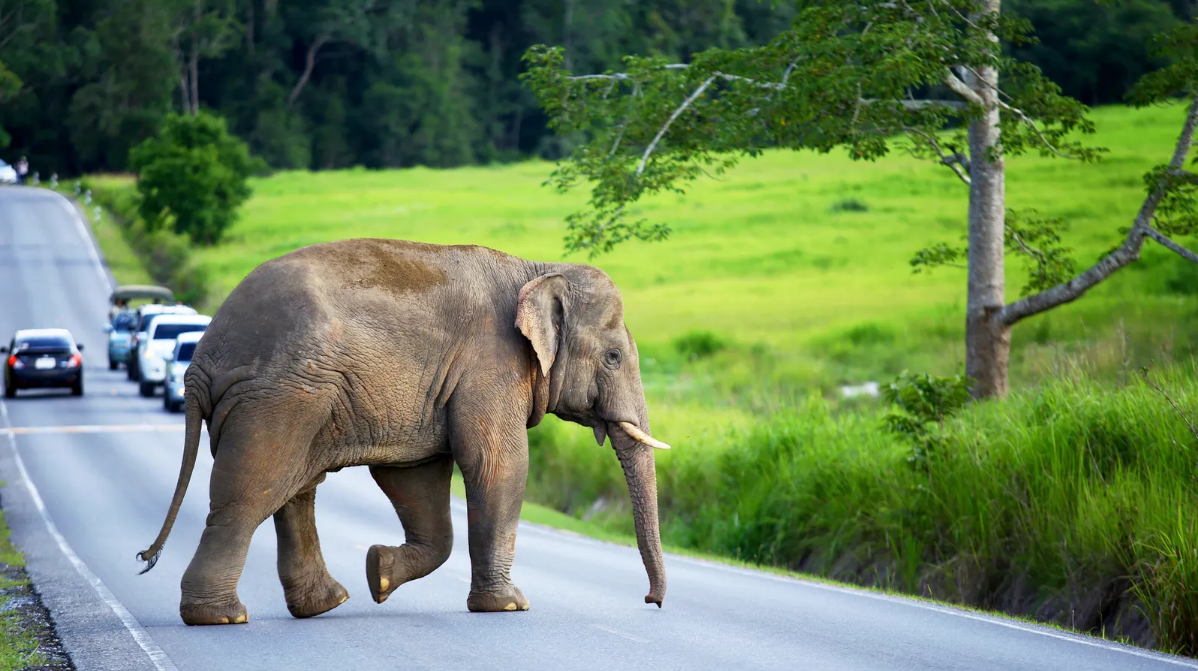
An elephant crosses a road in Thailand. Wildlife crossings such as underpasses can improve connectivity when roads bisect habitats. © Phubadee Na Songkhla/Shutterstock.co
Evan Freund, senior director of sustainable infrastructure at WWF-US, agrees. A lot of infrastructure that has negative impacts on communities and nature is the result of poor planning, he explains. Stakeholders (governments, engineers, local communities, and others) often don’t coordinate at the early stages of the conception, design, and financing of infrastructure projects to identify risks and opportunities. “By the time a shovel is in the ground, it’s too late,” he says.
But, Newman emphasizes, “WWF is not against infrastructure.” The world needs energy systems, water supplies, sanitation, and transportation. “Thriving economies are essentially impossible without it,” she adds. The focus, however, also needs to stay on wildlife connectivity and natural systems to maintain migratory patterns, species’ genetic diversity, and other ecological benefits.
That’s why WWF focuses on finding ways to ensure that the world’s future infrastructure will work with nature instead of against it.
Good practice
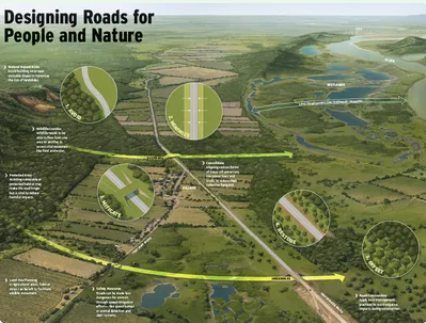
Infographic: Designing roads for people and nature © WWF/Matt Twombly
For more than a decade, Colombia has been exploring ways to integrate nature into road development. Three consecutive national governments developed, advanced, promoted, and have now solidified the GRI into law.
The need for the GRI was first identified because unsafe roads had been carved into precipitous cliffsides in the Andes, and landslides there had killed hundreds of people. In addition to taking nature and climate resilience into account, the GRI aims to make sure roads are safe for people too.
The guidelines were the brainchild of Rodrigo Botero, who founded the Foundation for Conservation and Sustainable Development (FCDS), a nonprofit that works on reducing the environmental impacts of roads in the Amazon.
After a peace agreement was signed in 2016 between the government of Colombia and the Revolutionary Armed Forces of Colombia, Botero realized that an onslaught of road construction was imminent in the Colombian Amazon, and this reaffirmed the urgent need for sustainable roads. While the conflict had restricted the movement of people and goods, he knew peace would have the opposite effect.
“Creating more sustainable infrastructure is of utmost importance for conserving the Amazon’s forests,” Botero says. “Our analysis shows that 93% of deforestation in the departments of Caquetá, Meta, and Guaviare is less than two kilometers from a road.”
Less than a decade ago, WWF-Colombia partnered with FCDS to support a collaboration between Colombia’s Ministry of Environment and Sustainable Development and Ministry of Transportation. The GRI is the result of years of their painstaking work.
“Through our work in the Andes-Amazon region, we have seen that poorly planned infrastructure can be a significant threat to ecological integrity and human well-being,” says Avecita Chicchón, program director of the Gordon and Betty Moore Foundation’s Andes-Amazon initiative—a crucial financial supporter of the GRI. “The green infrastructure approach is one of the most powerful tools we have for planning roads that have the potential to conserve Indigenous territories and intact ecosystems.”
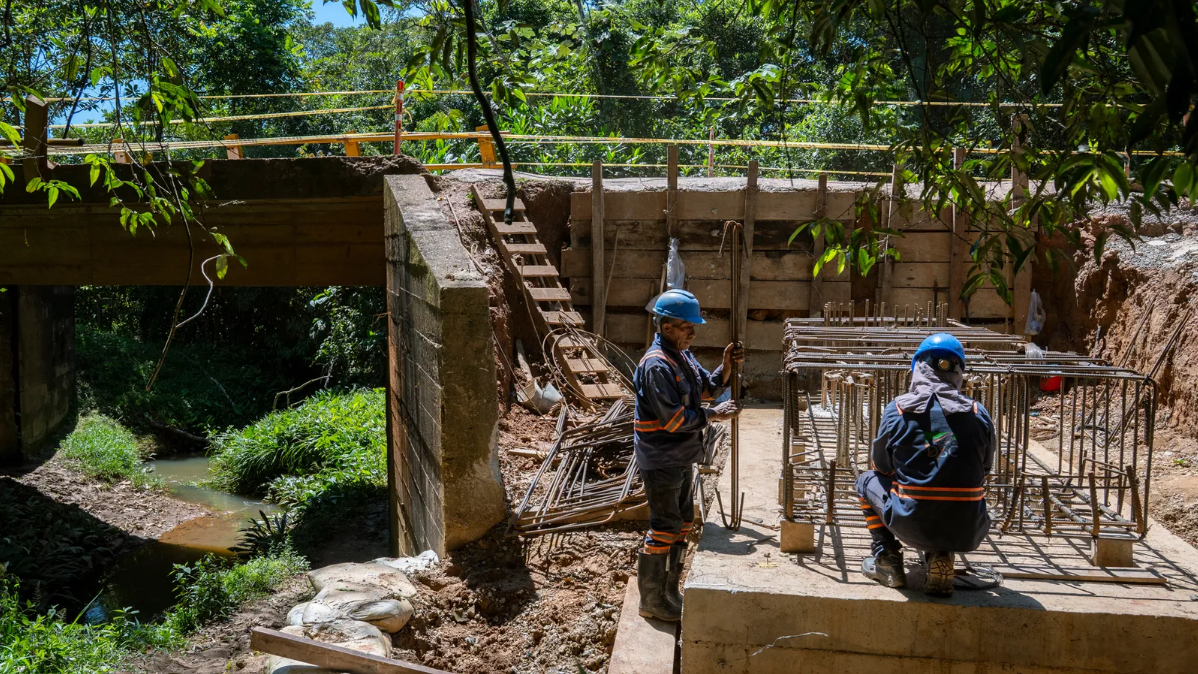
UNDER CONSTRUCTION: Miyer Henao and Maicol Perez at work in Guaviare. © WWF-US/Luis Bernardo Cano
Test case
As the GRI was being developed, its creators decided to test its guiding principles by applying them to the improvement of the road in Guaviare, which runs between two protected areas (Serranía de Chiribiquete National Natural Park and Nukak National Natural Reserve) in the Amazon.
Since the project launched, FCDS and WWF have been organizing workshops with key stakeholders and local leaders in Guaviare, who actively monitor the work. During the earliest planning stage, environmental impacts within 3 miles on both sides of the road were taken into consideration to minimize harm. The road is also being designed to make it resource efficient by sourcing local materials, for example, and repurposing construction debris.
WWF-Colombia’s Cesar Bernal, who lives in Guaviare and is closely involved in the work, describes other planned road interventions: “Five old, undersized bridges will be replaced. Steel arches will be added to help water flow better in areas prone to flooding. And wildlife crossing structures will be installed to help wildlife move freely.”
Well-designed bridges are particularly important so they can properly accommodate heavy water flows, including those in future climate projections; when they’re not built well, bridges and roads can wash away during severe weather events—or even cause or exacerbate flooding. Bridges along the Guaviare road are being modified to better accommodate changing water patterns and enable wildlife to cross via underpasses—open spaces along the riverbanks that maintain ecological connectivity.
Some other plans for the road: planting native trees nearby, using fencing to direct animals to wildlife crossings, and installing signage about wildlife presence to increase awareness among travelers.
The insights gained from the pilot project have also been invaluable in understanding the barriers to implementing the GRI. Chicchón feels that by developing—and applying—these guidelines, Colombia has taken an important step in becoming a regional leader in this arena. “It is our hope that these guidelines will inspire other countries to adopt similar policies for the benefit of people, nature, and climate,” she says.
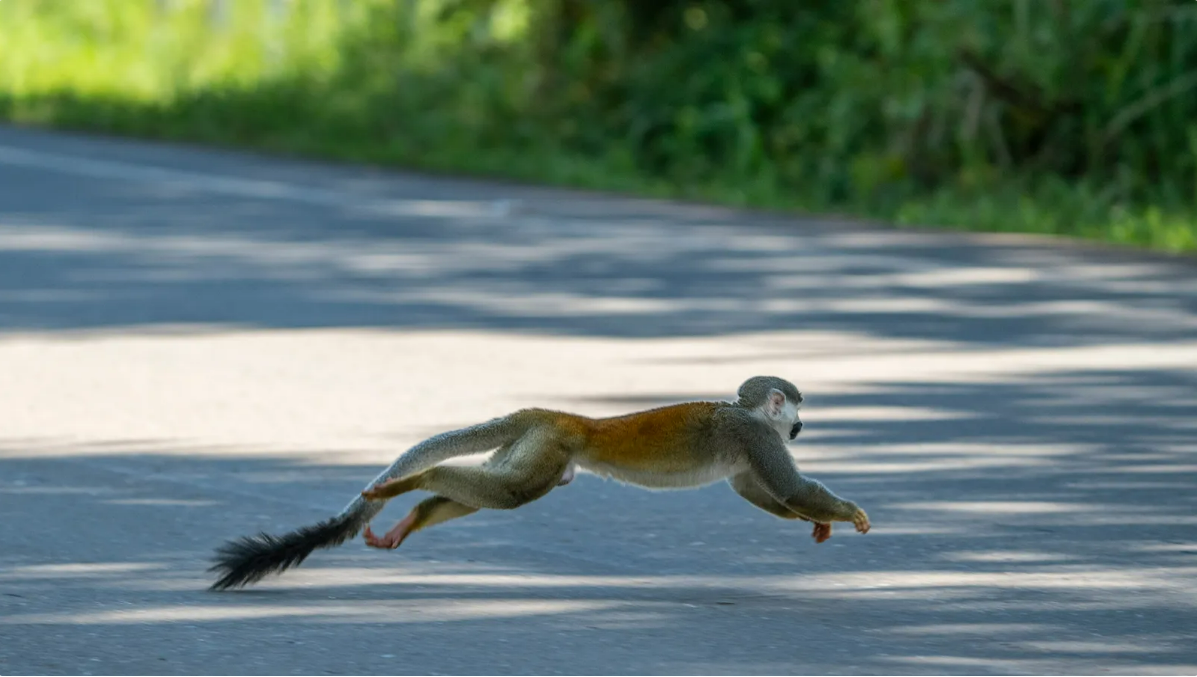
THE OTHER SIDE: A squirrel monkey crosses the Guaviare road. © WWF-US/Luis Bernardo Cano
Widening the lens
The Guaviare road is just one example of WWF’s work to influence the way infrastructure is built at a global scale. For instance, WWF has been developing recommendations for governments to avoid negative impacts of infrastructure on snow leopards, supporting wildlife-friendly infrastructure to help Asian elephants, and developing training materials for the world’s largest engineering association around nature-positive infrastructure.
One of WWF’s biggest infrastructure programs is the Greening Transportation Infrastructure Development (GRID) Integrated Program, funded by the Global Environment Facility (GEF).
“The GRID Integrated Program is a great example of how the GEF works with countries globally to meet the needs of nature and people through innovative approaches to sustainable infrastructure policy, planning, financing, and design,” says Hannah Fairbank, senior biodiversity advisor at the GEF.
GRID’s goal is to make sure implications for biodiversity and ecosystems are fully considered at the earliest stages of infrastructure development—particularly transportation infrastructure like roads, railroads, and ports—with a clear focus on avoiding habitat fragmentation in coastal areas and critical wildlife landscapes.
GRID has two components—a global platform and five government-led national projects—in collaboration with WWF, the Asian Development Bank, and the United Nations Environment Programme.
The goal is to fully implement the national projects in Malaysia, Suriname, Nepal, Ukraine, and the Philippines within five years, transitioning toward sustainable transportation infrastructure (ports in Malaysia and Suriname and roads in the other countries) that conserves and restores key coastal, marine, and terrestrial ecosystems.
WWF’s role in the program is to leverage partnerships and develop a global coordination platform to facilitate best practices around infrastructure planning, design, and financing worldwide. This will help the day-to-day work of planners, decision-makers, and infrastructure practitioners and drive policy change and innovation.
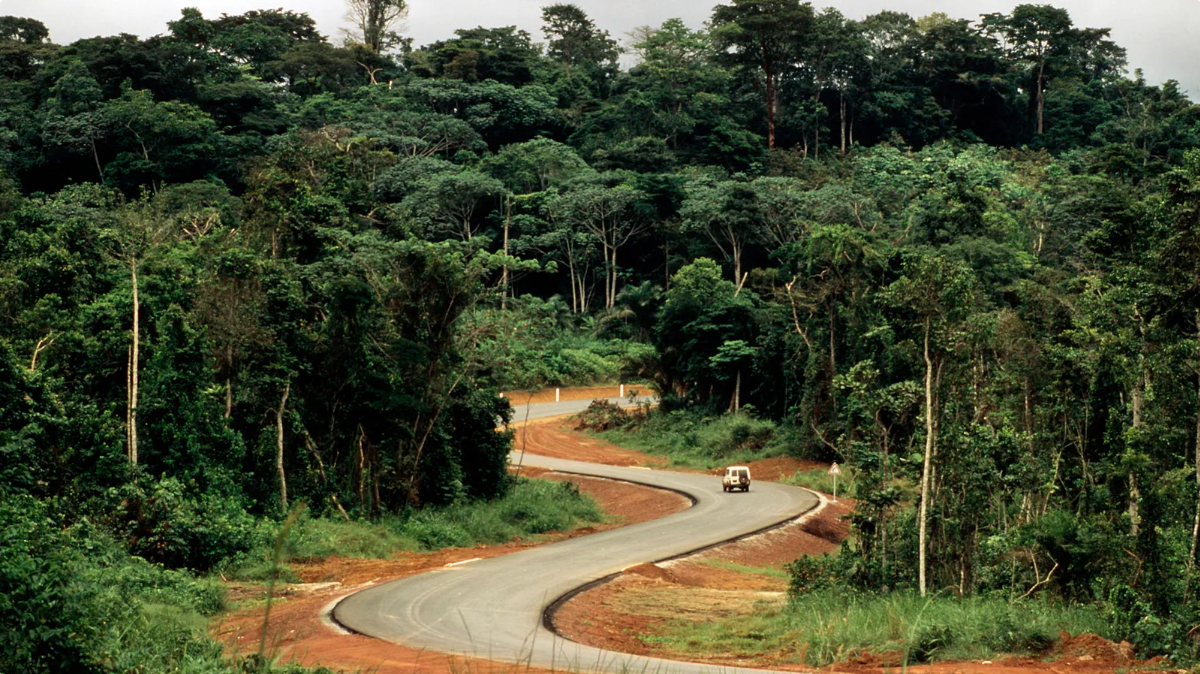
Land conversion around roads can be minimized with proper planning, such as implementing the mitigation hierarchy, during the earliest stages of an infrastructure project. © Michel Gunther/WWF
A global shift
While it’s clear that nature and communities can’t thrive without sustainable infrastructure, it’s equally apparent that a more systemic approach to infrastructure planning is going to take a significant shift in people’s thinking.
Newman says the first step of creating nature-focused infrastructure policies and standards, while also bringing a diverse set of stakeholders on board, is within reach.
But is it really possible to inspire the finance sector to demand such regulations, for the planners to say, “We have to make sure we’re not undermining our wetlands or critical habitats,” and for the engineers to shift their norms and practices?
Newman believes it is. And though the work ahead may seem daunting, she sees a silver lining.
“Roughly 75% of the infrastructure that will exist globally by 2050 hasn’t been built yet,” she says, with a deliberate shake of her head to emphasize her point. “That’s a staggering amount of new infrastructure, but, thankfully, the pace of investment in this growth is slow. This gives us time to shift the ways we think about and develop these types of projects so that both people and nature can thrive.”